+91 94965 02248 contact@actymed.in Thodupuzha: Open 24/7
Book
🦵

Knee Pain

Advanced diagnosis and personalized treatment for all types of knee pain.

Overview

Knee pain affects people of every age — from young athletes and weekend runners to office workers and grandparents. It can range from a mild ache after activity to sharp pain that interferes with walking, stairs, sleep or sport. Because the knee is the body’s largest weight-bearing joint, even small problems tend to grow if they are ignored.

Most knee pain is highly treatable once the true cause is identified. At ACTYMED, our sports-medicine and rehabilitation team combines accurate structural diagnosis with modern therapies and evidence-informed Ayurveda to get you moving again — without unnecessary surgery.

We treat sports injuries, ligament and meniscus problems, knee osteoarthritis, kneecap (patellar) pain, tendon problems and post-surgical rehabilitation across all three ACTYMED clinics.

Signs & Symptoms

  • Pain while walking, running or climbing stairs
  • Swelling or puffiness around the knee
  • Stiffness after rest or first thing in the morning
  • Difficulty fully bending or straightening the leg
  • Clicking, popping or locking sensations
  • A feeling of the knee giving way under load

Causes

  • Sports and overuse injuries (runner's knee, jumper's knee)
  • Ligament injuries such as ACL and MCL sprains or tears
  • Meniscus (cartilage) tears
  • Knee osteoarthritis and age-related wear
  • Kneecap (patellar) tracking problems
  • Inflammatory arthritis such as rheumatoid arthritis and gout
  • Joint infection (septic arthritis) — rare but serious, needs urgent care
  • Bursitis and inflammation of the joint lining
  • Referred pain from the hip or lower back

Risk Factors

  • Age over 40
  • Sports involving jumping, pivoting or sudden direction change
  • Previous knee injury
  • Being overweight
  • Jobs with prolonged kneeling or squatting
  • Muscle weakness or imbalance around the knee

Understanding the Anatomy

The knee is a hinge joint where the thigh bone (femur) meets the shin bone (tibia), protected in front by the kneecap (patella). The joint surfaces are covered in smooth cartilage, and two C-shaped shock absorbers — the menisci — sit between the bones to spread load.

Four main ligaments (ACL, PCL, MCL, LCL) hold the bones together and control twisting and side-to-side movement, while the quadriceps and hamstring muscles power and protect the joint.

Because the knee sits between the hip and the ankle, problems in either neighbour — weak hip muscles, flat feet, stiff ankles — frequently show up as knee pain. That is why we always assess the whole leg, not just the knee.

Types & Classification

  • By onset — acute knee pain (sudden, usually after injury) vs chronic knee pain (persisting beyond 3 months)
  • By location — front (patellofemoral), inner (medial), outer (lateral) or back (posterior) of the knee, each pointing to different structures
  • By structure — ligament, meniscus, tendon, cartilage or joint-surface problems
  • Knee osteoarthritis is graded on X-ray from Grade 1 (minor) to Grade 4 (severe)

How We Diagnose It

  • Detailed history of your pain, training load and injury mechanism
  • Movement, gait and single-leg control assessment
  • Orthopaedic special tests for ligament stability, meniscus and kneecap problems
  • Assessment of the hip, ankle and core as contributing factors
  • X-ray or MRI only when it will change the treatment plan
  • Blood tests if an inflammatory cause is suspected

If Left Untreated

  • Chronic pain and progressive loss of knee movement
  • Muscle wasting (especially the quadriceps) from guarding and inactivity
  • An altered walking pattern that starts to overload the hip and lower back
  • Faster progression of cartilage wear under poor movement mechanics
  • Steadily shrinking activity levels, fitness and independence

The ACTYMED Advantage

  • Combined sports-medicine and Ayurvedic assessment of the whole kinetic chain — hip, knee, ankle and gait, not just the painful spot
  • A precise structural diagnosis before any treatment is chosen
  • Non-surgical first: manual therapy, dry needling, taping and graded exercise before injections or surgery are even discussed
  • Evidence-informed Ayurvedic therapies such as Janu Basti integrated with modern rehabilitation
  • A personalised loading programme built around your sport, job and goals
  • Clear return-to-activity milestones — we restore function, not just mask pain

How We Treat It

Recovery & Prognosis

  • Simple strains often settle in 2-6 weeks with structured care
  • Ligament and meniscus problems typically need 6-12 weeks of guided rehabilitation
  • Most people with knee osteoarthritis improve significantly within 8-12 weeks of consistent exercise therapy
  • Return to desk work is usually immediate; heavy manual work may need short-term modification
  • Return to sport is cleared by strength and stability testing, not just the absence of pain

Prevention Tips

  • Strengthen the thigh and hip muscles with twice-weekly resistance work
  • Increase running or training load gradually — no more than about 10% per week
  • Maintain a healthy body weight to reduce joint load
  • Warm up properly and include landing and agility drills in sport
  • Wear appropriate, well-maintained footwear for your activity
  • Deal with small knee niggles early, before they become chronic

Home Care & Self-Management

Do's

  • Keep moving within a comfortable range — motion nourishes the joint
  • Ice 15-20 minutes at a time during the first 48 hours of a flare-up or injury
  • Keep strengthening gently even after the pain eases
  • Take stairs one step at a time during painful phases
  • Use a pillow between the knees if side-sleeping aggravates the pain

Don'ts

  • Don't push through sharp, stabbing or steadily worsening pain
  • Don't take complete bed rest — inactivity weakens the knee further
  • Avoid deep squats, lunges and jumping during an acute flare
  • Don't rely on self-prescribed painkillers for weeks without a diagnosis
  • Never ignore swelling, locking or the knee giving way — get assessed

Frequently Asked Questions

When should I see a doctor for knee pain?

See a clinician if pain lasts more than a week, keeps returning after activity, or is accompanied by swelling, locking, clicking with pain, or a feeling of the knee giving way. Sudden severe pain after an injury, inability to bear weight, or a visibly deformed knee needs assessment the same day.

Do I need an X-ray or MRI for my knee pain?

Not always. Most knee problems can be diagnosed with a detailed history, movement assessment and orthopaedic tests. Imaging is used when it will actually change the treatment plan — for example, suspected fractures, significant ligament or meniscus tears, or advanced arthritis.

Can knee pain be treated without surgery?

In most cases, yes. International guidelines recommend structured exercise therapy, load management and hands-on treatment as first-line care for most knee conditions, including osteoarthritis and many meniscus tears. Surgery is reserved for specific injuries where conservative care genuinely cannot restore function.

Is walking good or bad for knee pain?

For most knee conditions, comfortable walking is good — movement nourishes the joint cartilage and keeps the muscles active. The key is the right dose: short, regular walks on even ground, staying below the level that flares your pain for more than 24 hours.

How is knee pain treated at ACTYMED?

After a structural diagnosis, your plan may combine manual therapy, dry needling, kinesiology taping, a progressive exercise programme, Ayurvedic therapies such as Janu Basti, and guidance on load, footwear and body weight. The exact mix depends on your diagnosis, age, sport or job, and goals.

How long does knee pain take to heal?

Simple strains often settle in 2–6 weeks. Ligament and meniscus problems typically need 6–12 weeks of guided rehabilitation. Osteoarthritis is managed long-term, but most people feel significantly better within 8–12 weeks of consistent, structured care.

Is my knee pain arthritis?

Not necessarily. Knee pain in younger and active people is more often from the kneecap, tendons, ligaments or menisci. Even when X-rays show age-related changes, the pain often comes from treatable muscle and loading problems — X-ray findings and pain do not always match.

Can Ayurveda really help knee pain?

Used alongside modern rehabilitation, specific Ayurvedic therapies help reduce pain and stiffness so you can exercise and recover better. At ACTYMED we use Ayurveda in an evidence-informed way — as part of a measurable treatment plan, never as a replacement for accurate diagnosis.

Should I stop sports completely if my knee hurts?

Rarely. Complete rest usually makes the knee weaker and the return harder. In most cases we modify your training — reducing load, swapping aggravating movements, and rebuilding capacity — so you stay active while the knee recovers.

Does clicking or cracking in my knee mean damage?

Painless clicking is very common and usually harmless — it is often just fluid and tendon movement. Clicking that comes with pain, swelling or locking, however, should be assessed, as it can point to a meniscus or cartilage problem.

What the Evidence Says

  • Exercise therapy is first-line treatment for knee osteoarthritis in all major international guidelines (OARSI, NICE)
  • Randomised trials show structured rehabilitation matches arthroscopic surgery for degenerative meniscus tears
  • Dry needling combined with exercise shows meaningful short-term pain reduction in kneecap (patellofemoral) pain
  • Losing even 5-10% of body weight measurably reduces knee pain in overweight patients

Specialists Who Can Help

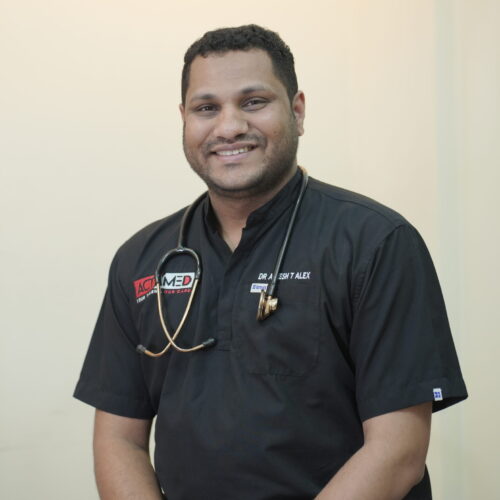
Dr. Ajeesh T Alex

Dr. Ajeesh T Alex

Ayurvedic Orthopaedics & Sports Medicine

Profile

From Our Knowledge Centre