+91 94965 02248 contact@actymed.in Thodupuzha: Open 24/7
Book
🦿

Groin Strain (Adductor Injury)

Inner-thigh pain with kicking and cutting — active strengthening, proven in The Lancet, is the treatment.

Overview

Groin strains — injuries to the adductor muscles of the inner thigh — are a signature injury of football, hockey and any sport built on kicking, cutting and rapid direction change. In the UEFA elite-club injury study they account for roughly 23% of all muscle injuries, second only to hamstrings. Acute strains announce themselves with sharp inner-thigh pain during a kick or lunge; the trickier version is long-standing groin pain that grumbles on for months.

Groin pain is also a diagnostic minefield — the same region hosts adductor, hip-flexor, abdominal-wall and hip-joint problems, formally organised by the 2015 Doha agreement classification we use in assessment. Getting the source right changes everything.

The treatment evidence here is unusually decisive: a landmark randomised trial in The Lancet (Hölmich et al., 1999) showed active strengthening beat passive treatments (massage, stretching, modalities) so clearly for long-standing adductor pain that it redefined care — and a large RCT of the Copenhagen adduction exercise cut groin injuries in footballers by 41%. ACTYMED’s programme is built on both.

Signs & Symptoms

  • Sharp inner-thigh or groin pain during a kick, lunge or direction change
  • Tenderness along the inner thigh or at the pubic bone attachment
  • Pain squeezing the knees together
  • Pain accelerating, cutting or kicking; straight running often tolerable
  • Stiffness after sitting or next morning
  • In chronic cases: dull groin ache that warms up, then returns worse after sport

Causes

  • Eccentric overload during kicking, cutting and deceleration
  • Sudden change-of-direction demands beyond current adductor capacity
  • Training spikes — preseason and tournament congestion
  • Fatigue late in matches
  • Previous groin injury with incomplete rehabilitation
  • Hip joint stiffness shifting load onto the adductors

Risk Factors

  • Sports built on kicking and cutting — football, hockey, futsal
  • Previous groin injury — the dominant risk factor
  • Low adductor squeeze strength
  • Male sex in football cohorts
  • Congested fixture schedules
  • Reduced hip rotation range

Understanding the Anatomy

Five adductor muscles line the inner thigh; adductor longus — running from the pubic bone down the thigh — is the one injured in the great majority of strains, usually near its pubic attachment where tendon and bone meet.

The adductors share their pubic anchor with the abdominal wall, forming a load-sharing junction around the pubic symphysis — the reason groin, lower-abdominal and pubic problems blur together clinically and need structured classification (the Doha agreement) to separate.

Beyond pulling the leg in, the adductors stabilise the pelvis in single-leg stance and brake the swinging leg in kicking — high eccentric demands that rehabilitation must specifically rebuild.

Types & Classification

  • Acute adductor strain — Grade 1 (minor, 1-2 weeks), Grade 2 (partial tear, 3-6 weeks), Grade 3 (major tear, 8-12+ weeks; rare avulsions considered surgically)
  • Long-standing adductor-related groin pain — months of activity-related ache; treated with the proven active programme
  • Doha classification of groin pain: adductor-related, iliopsoas-related, inguinal-related, pubic-related — plus hip-joint-related
  • Mixed presentations are common in chronic cases

How We Diagnose It

  • Injury story and pain map — kick, cut or gradual onset
  • Palpation of adductor origin and muscle belly
  • Adductor squeeze test — pain and strength at several hip angles (also our progress metric)
  • Doha-framework screening of hip flexors, abdominal wall and pubic region
  • Hip joint assessment — rotation range, impingement tests
  • Imaging (ultrasound/MRI/X-ray) for major tears, atypical or stubborn cases

If Left Untreated

  • Progression from acute strain to months-long adductor-related groin pain when returned too fast
  • Chronic pubic-region overload (osteitis pubis pattern) in unmanaged kicking athletes
  • Strength and confidence loss changing cutting mechanics — spreading load to hip and back
  • Missed hip-joint pathology mislabelled as recurrent 'groin strain'

The ACTYMED Advantage

  • Doha-classification assessment — the groin's five look-alike sources are separated before treatment starts
  • Active-first programme modelled on the Lancet-proven Hölmich protocol, not passive massage-and-rest cycles
  • Squeeze-test strength tracking at every stage — recovery in numbers
  • Copenhagen adduction exercise built into rehab and your permanent prevention plan (41% fewer groin injuries in trial data)
  • Kicking and cutting rebuilt as tested progressions, not hopeful returns
  • Dry needling and manual therapy quiet the guarded tissue so loading can progress

How We Treat It

Recovery & Prognosis

  • Acute grade 1: typically 1-2 weeks to return with structured loading
  • Acute grade 2: typically 3-6 weeks; kicking returns last
  • Acute grade 3: 8-12+ weeks, staged; rare avulsions may need surgical opinion
  • Long-standing adductor-related pain: expect 8-12+ weeks of progressive strengthening — the landmark trial assessed success around 4 months; most improve steadily within it
  • Return is cleared by squeeze-strength symmetry and pain-free kicking/cutting progressions, not by the calendar alone

Prevention Tips

  • Copenhagen adduction exercise weekly — 41% reduction in trial
  • Maintain adductor squeeze strength year-round; retest in preseason
  • Build kicking and cutting volumes progressively after breaks
  • Keep hip rotation mobility maintained
  • Manage fixture congestion and fatigue
  • Finish rehab fully after any groin episode — chronicity is bred by early exits

Home Care & Self-Management

Do's

  • Start gentle isometric squeezes early — they reduce pain and start rebuilding
  • Keep straight-line fitness going while cutting/kicking rebuild
  • Progress loading even after pain settles — capacity lags comfort
  • Warm up adductors specifically before kicking sports
  • Keep the Copenhagen exercise after discharge

Don'ts

  • Don't rest passively for weeks — the trial evidence is against it
  • Avoid forced groin stretching in the acute phase
  • Don't return to full kicking without strength testing
  • Don't ignore groin pain that persists beyond 6 weeks — get it classified properly
  • Avoid repeated cortisone as a substitute for rehabilitation

Frequently Asked Questions

How long does a groin strain take to heal?

Grade-dependent, honestly: grade 1 strains typically return in 1–2 weeks; grade 2 in 3–6 weeks; grade 3 (major tears) 8–12 weeks or more. Long-standing groin pain that has lingered for months follows a different clock — the proven active programme typically needs 8–12+ weeks of consistent strengthening, and the Lancet trial measured success at around four months. Anyone promising a fixed fortnight for every groin is guessing.

Why does my groin hurt when I kick or change direction?

The adductors don’t just pull the leg inward — they stabilise the pelvis and decelerate the leg during cutting and kicking. Those actions load them eccentrically at high force, exactly where an under-conditioned adductor fails.

Is rest a good treatment?

For long-standing groin pain, no — that’s the clearest message in the evidence. The Lancet trial compared active strengthening against passive care: the active group vastly outperformed. Short protection after an acute tear, yes; then loading is the treatment.

Could it be a hernia or my hip instead?

Genuinely possible — inguinal-related, pubic-related and hip-joint problems (including FAI and early arthritis) all present as “groin pain”. Our assessment follows the Doha classification to separate them; unclear or atypical cases get imaging or referral rather than a guessed label.

What is the Copenhagen exercise?

A side-plank adduction exercise that loads the adductors eccentrically. In a randomised trial of 45 football teams (Harøy et al., BJSM 2019), adding it to training reduced groin problems by 41%. It features in both our rehab progressions and every player’s prevention plan at discharge.

Can I keep training during rehab?

Mostly yes — straight-line running usually stays comfortable well before cutting and kicking do, and we programme around the painful actions while adductor capacity rebuilds. Complete rest usually just delays the same rehabilitation.

When can I kick at full power again?

When testing says so: adduction strength back within ~10% of the other side (measured by squeeze tests), pain-free progressive kicking build, and change-of-direction drills at speed without next-day reaction. Kicking is the last skill back because it is the highest adductor load.

What does ACTYMED’s programme look like?

Accurate source diagnosis first (Doha framework), then: early isometric squeezes for pain and strength, progressive adduction strengthening through range, trunk-pelvis control work, running to cutting to kicking progressions, dry needling and manual therapy for the guarded overactive tissue — finishing with squeeze-test clearance and a Copenhagen-based prevention block.

What the Evidence Says

  • Hölmich et al. (The Lancet 1999): active strengthening dramatically outperformed passive treatment for long-standing adductor-related groin pain — the trial that redefined care
  • Harøy et al. (BJSM 2019): Copenhagen adduction programme reduced groin problems by 41% in a 45-team RCT
  • Doha agreement (Weir et al., BJSM 2015) provides the groin-pain classification our assessment follows
  • Ekstrand et al. (AJSM 2011): adductor injuries = ~23% of muscle injuries in elite football
  • Squeeze-test strength monitoring is validated for tracking adductor recovery

Specialists Who Can Help

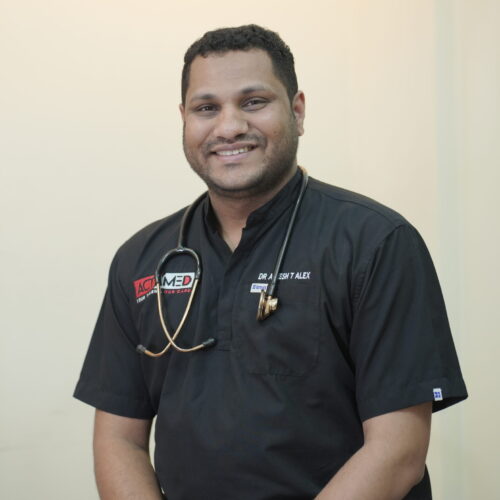
Dr. Ajeesh T Alex

Dr. Ajeesh T Alex

Ayurvedic Orthopaedics & Sports Medicine

Profile