🦿

Osgood-Schlatter Disease (Growing Athlete’s Knee)

A painful bump below the knee in growing, active children - self-limiting, manageable, and almost never a reason to stop sport entirely.

Overview

Osgood-Schlatter disease is the most common cause of knee pain in growing, active children – a painful, tender bump on the shin just below the kneecap, worse with running, jumping, kneeling and stairs. Despite the alarming word “disease,” it is a benign and self-limiting condition of the growth years, and understanding that is the first and most important part of treatment.

During a growth spurt, the shin bone has a soft growth centre where the powerful knee tendon attaches. Repeated pulling from running and jumping irritates this immature attachment, and the body lays down extra bone in response – creating the characteristic bump. Once the growth plate matures at the end of adolescence, the process ends. ACTYMED”s approach is honest and reassuring: keep the young athlete playing at a comfortable level, manage the load rather than banning sport, and address the flexibility and strength factors that reduce the strain – while recognising the rare red flags that need more attention.

Signs & Symptoms

  • Pain and a tender bony bump just below the kneecap, on the shin
  • Worse with running, jumping, kneeling and stairs
  • Eases with rest, flares with sport
  • Usually one knee, sometimes both
  • A visibly enlarged, hard bump over the shin tubercle
  • Pain on straightening the knee against resistance

Causes

  • Growth-spurt vulnerability - bones lengthen faster than muscles and tendons can keep pace
  • Repetitive quadriceps traction on the still-maturing shin growth plate (tibial tubercle apophysis)
  • High jumping and running loads during the adolescent growth phase
  • Tight quadriceps pulling harder on the tubercle during rapid growth
  • Sudden training-load increases in a growing athlete

Risk Factors

  • Age 10-15 in the growth spurt (a little earlier in girls, later in boys)
  • Active in running and jumping sports - football, basketball, volleyball, athletics, dance
  • Rapid recent growth
  • Reduced quadriceps and hamstring flexibility
  • Sudden rises in sporting activity
  • Boys slightly more often, though the gap is narrowing as girls' sport participation rises

Understanding the Anatomy

In a growing child the shin bone has a growth centre (apophysis) at the tibial tubercle, where the patellar tendon attaches - this cartilage-rich zone is softer and more vulnerable than mature bone.

Every powerful quadriceps contraction during jumping and running tugs the patellar tendon on this immature attachment; repeated traction irritates and partially pulls at the apophysis, which the body reinforces with extra bone - producing the characteristic enlarged, tender bump.

It is a self-limiting condition of growth: once the growth plate matures and closes at the end of adolescence, the process ends - the bump may remain but the pain resolves. This biology is why reassurance, not alarm, is the right frame.

Types & Classification

  • Typical Osgood-Schlatter - traction apophysitis at the tibial tubercle (the shin bump)
  • Sinding-Larsen-Johansson syndrome - the same process at the lower pole of the kneecap (the other end of the tendon), also in adolescents
  • Graded by symptom severity and impact on sport rather than by imaging
  • Rare complication variant: a separate ossicle within the tendon that stays painful into adulthood

How We Diagnose It

  • Clinical diagnosis - the age, the activity, and pinpoint tenderness over an enlarged tibial tubercle are enough in almost all cases
  • Pain reproduced by resisted knee extension
  • X-ray is not routinely needed - reserved to exclude other problems if the picture is atypical (rest pain, night pain, swelling of the joint itself)
  • Assessment of quadriceps and hamstring flexibility and load history
  • Reassurance that this is a recognised, benign, self-limiting condition

If Left Untreated

  • Prolonged discomfort through the growing years if loads are never modified
  • Rarely, a persistent painful ossicle in the tendon that can cause symptoms into adulthood
  • Deconditioning and lost sporting enjoyment from unnecessary complete rest
  • Very rarely, avulsion of the tubercle with a sudden forceful jump (a different, acute injury needing urgent care)

The ACTYMED Advantage

  • Reassurance first, honestly - most families arrive worried, and the truth is calming: this is benign, self-limiting and rarely needs a child to stop sport entirely
  • Activity modification, not activity elimination - we keep young athletes playing at a tolerable level while managing load
  • Quadriceps and hamstring flexibility and hip/thigh strengthening to reduce traction
  • Simple, effective measures: load management, warm-up, sometimes an infrapatellar strap for comfort
  • Clear return-to-full-sport guidance as symptoms settle
  • Recognising the rare red flags (joint swelling, rest/night pain, acute avulsion) that need more

How We Treat It

💳 Inpatient treatment for this condition may be covered by your health insurance. ACTYMED supports both cashless and reimbursement claims, and our team handles the entire documentation for you. Check your eligibility →

Recovery & Prognosis

  • Symptoms typically wax and wane over months, flaring with activity and settling with relative rest
  • Most cases fully resolve within 12-24 months as the growth plate matures
  • Sport can usually continue at a modified, comfortable level throughout - complete withdrawal is rarely necessary
  • The bony bump often remains for life but becomes painless once growth finishes
  • Persistent pain after skeletal maturity (a retained ossicle) is uncommon and separately treatable

Prevention Tips

  • Manage training load through growth spurts - watch for rapid height changes
  • Keep quadriceps and hamstrings flexible
  • Warm up properly before running and jumping sport
  • Do not push through escalating knee pain during a growth phase
  • Balance high-jumping-load sports with recovery
  • Reassure - fear of the bump causes more lost sport than the bump itself

Home Care & Self-Management

Do's

  • Keep playing at a level that stays comfortable - modify, do not stop
  • Stretch quadriceps and hamstrings regularly
  • Use ice after sport for comfort
  • Consider an infrapatellar strap during activity if it helps
  • Scale training back temporarily during bad flares, then rebuild

Don'ts

  • Do not force a child to give up all sport out of fear - it is rarely necessary
  • Do not push through severe, worsening pain
  • Do not worry that the permanent bump means damage - it is normal healing bone
  • Do not ignore true joint swelling, rest pain or night pain - those are not typical Osgood-Schlatter and need review
  • Avoid sudden return to full jumping load after a flare

Frequently Asked Questions

Does my child have to stop playing sport?

Almost never entirely. The right approach is modification, not elimination – keeping activity at a level that stays comfortable, scaling back during bad flares, then rebuilding. Forcing a child to give up all sport is rarely necessary and often does more harm (lost fitness, lost enjoyment) than the condition itself. We help families find that workable level.

Is it dangerous? Will it cause lasting damage?

No. Osgood-Schlatter is benign and self-limiting – it does not damage the knee joint or cause arthritis. The bony bump often stays for life, but it becomes painless once growth finishes. The honest, reassuring truth is that this resolves on its own as your child matures; our job is to keep them comfortable and active while it does.

How long will it last?

It typically comes and goes over months, flaring with activity, and most cases fully settle within 12-24 months as the growth plate matures. It can feel long to a young athlete, which is exactly why staying in sport at a modified level – rather than waiting it out on the sidelines – matters so much for their fitness and morale.

What actually helps the pain?

Load management is the foundation – dialling activity to a comfortable level. Alongside that, stretching the quadriceps and hamstrings reduces the tendon”s pull, strengthening work helps, ice after sport eases soreness, and an infrapatellar strap gives some children comfort during activity. Simple measures, honestly applied, are what work here – there is no need for injections or aggressive treatment.

When should I be worried and seek review?

Osgood-Schlatter causes activity-related pain over the shin bump. Get it checked if there is swelling of the knee joint itself, pain at rest or at night, fever, or if a sudden forceful jump caused severe pain and inability to straighten the knee (a rare avulsion needing urgent care). These are not typical of Osgood-Schlatter and deserve a proper look – which is part of why an initial assessment is worthwhile even for a “classic” case.

Is surgery ever needed?

Essentially never during childhood – it is not a surgical condition. The only uncommon exception is an adult who still has pain from a separate small bone fragment (ossicle) left in the tendon after growth finished; if that persists and limits them, removing the ossicle is a small, effective procedure. For the growing child, the answer is always reassurance, load management and time.

What the Evidence Says

  • Gholve et al. (Current Opinion in Pediatrics 2007): Osgood-Schlatter as a self-limiting traction apophysitis of adolescence
  • Ladenhauf et al. (Current Opinion in Pediatrics 2020): activity modification and load management as mainstay; reassurance and continued modified sport
  • Neuhaus et al. (systematic review): benign natural history with resolution around skeletal maturity
  • Circi et al. (2017): outcomes and the small subset with a persistent ossicle requiring later treatment

Specialists Who Can Help

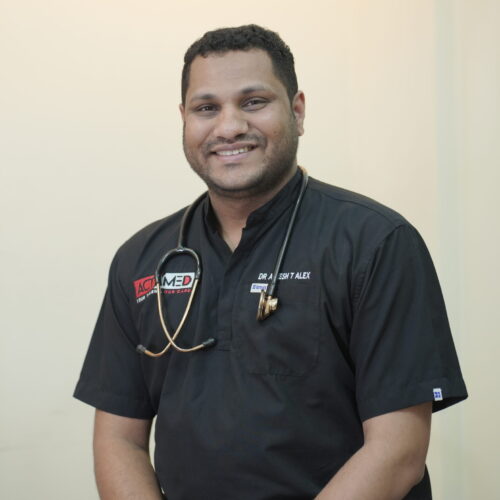
Dr. Ajeesh T Alex

Dr. Ajeesh T Alex

Ayurvedic Orthopaedics & Sports Medicine

Profile